
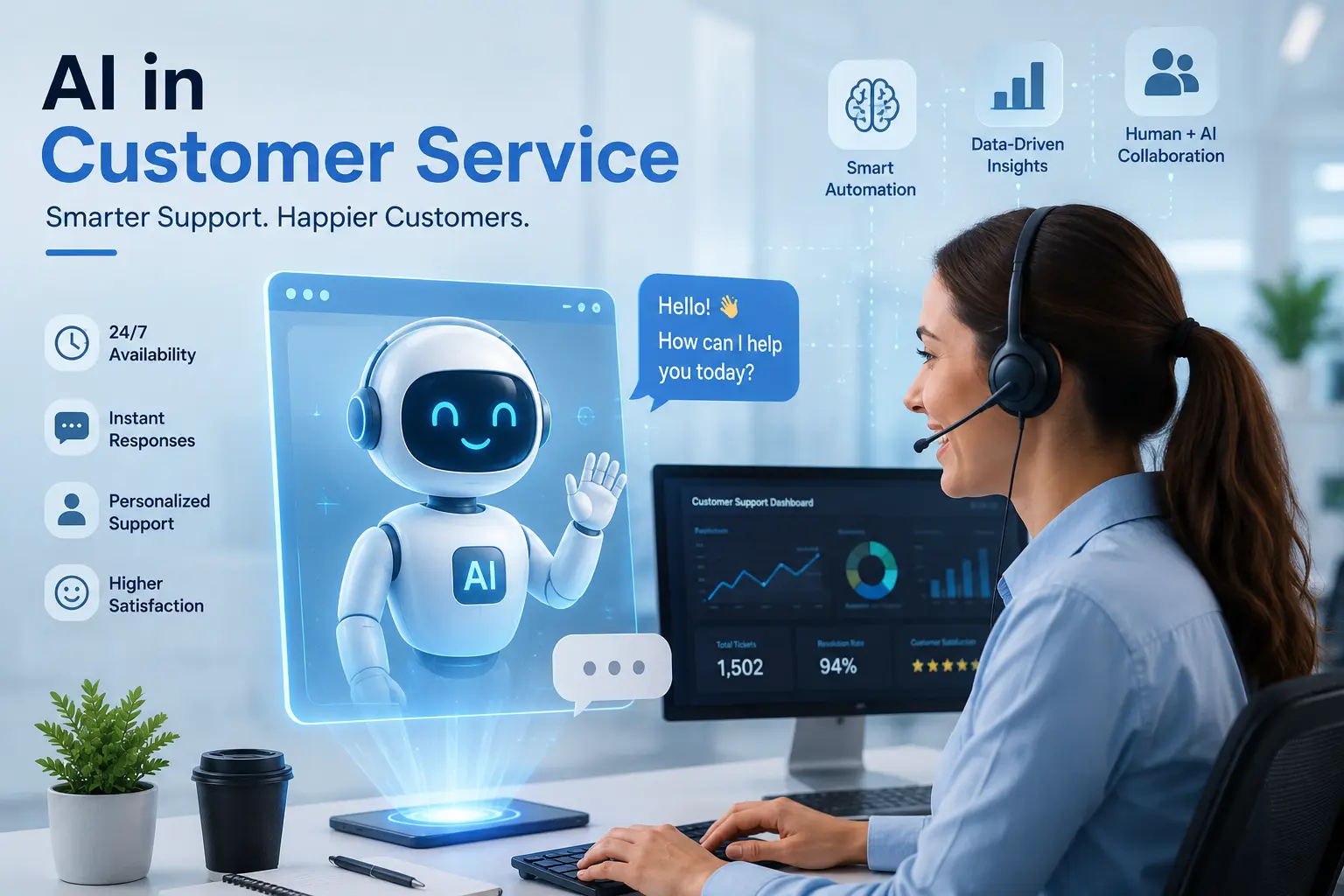
There have been significant changes in customer service in recent years. In today’s customer service landscape, AI in customer service is being leveraged to enable businesses to respond more quickly, resolve issues with precision, and deliver outstanding customer experiences. Companies use intelligent automation to supplement human agents to provide a fast and personalized support experience. Today’s customers want answers now. Salesforce research claims that nearly 73 percent of customers desire businesses to be aware of their needs and more than 60% are expecting a response within minutes! The growing demands require that companies employ AI-based solutions that provide accurate support 24/7.
Unlike standard chatbots that adhere to rigid rules, contemporary AI can comprehend conversations, grasp customer intent, and complete legitimate organizational jobs. It can have access to customer data, make adjustments to accounts, refund money and even make personalized recommendations during a discussion. Companies also see the monetary benefits of smart automation. By leveraging customer support AI, businesses can decrease repetitive tasks, speed up response times, and enhance customer satisfaction, all while maintaining manageable costs.
At Aidukes, we believe that AI technology delivers the best results when combined with human expertise. This balanced approach maximizes efficiency while preserving the personal, empathetic touch that customers cherish most.
Why Businesses Are Investing in AI in Customer Service
Customer expectations are continually increasing and businesses have to meet those expectations. Having more support teams can help in solving minor issues initially, but can lead to higher costs without improving the customer experience. AI in customer service is a Better and Scalable Solution. Nowadays, firms are able to reach out to thousands of customers simultaneously using the power of artificial intelligence. AI can give quick and accurate answers to the queries of customers on multiple platforms such as live chat, e-mail, social media and messaging apps.
It can help businesses learn more about their operations as well. Each customer engagement generates data that is helpful in identifying any repetitive issues, improving products and adjusting customer service. In the age of digital transformation, AI is no longer an extra edge for a business but is an essential business tool in all industries.
What Is Customer Support AI?
Customer support AI is intelligent software designed to handle customer interactions through various technological features like Large Language Models, Machine Learning and Natural Language Processing. These systems are able to read the queries of customers, identify what the customer wants, locate the information and produce answers like a human being.
In contrast to the old-fashioned chatbots that have a set of pre-written scripts, AI is able to comprehend the dialogue and react to different contexts. It recalls the past dialogues and comprehends customer requirements and preferences.
State-of-the-art AI solutions are also linked to CRM, payment gateways, stock management programs, shipping platforms and knowledge base. These integrations enable AI to perform genuine jobs rather than just addressing questions. AI can confirm an order, update delivery addresses, reset passwords, process refunds or schedule appointments, for instance, without a customer having to be passed from one department to another. The blend of intelligence and automation qualifies customer support AI as one of the most beneficial technologies for contemporary businesses.
How AI in Customer Service Works
All interactions powered by AI start with understanding the customer. Rather than looking for specific words, AI reads entire sentences and sees what they mean.
Understanding Customer Intent
Advanced language models are able to understand and read natural conversations the same way human agents do. They are aware of various writing styles, mistakes in spelling, slang and follow up questions, whilst keeping conversation context. This capability ensures that AI can accurately respond to the same customer issue, no matter how it is phrased.
Accessing Business Information
As soon as the AI understands the request, it sifts through connected databases, customer records, FAQs, order histories, and internal documentation to retrieve the most relevant information. By integrating with real-time business data, the AI delivers precise answers rather than generic responses.
Generating Personalized Responses
One of the strengths of generative AI in customer service is that of creating customized conversation. AI does not provide the customer with an answer by selecting answers on a preset list but instead provides tailored answers that are based on the needs of a particular customer. The process guarantees that the customer is satisfied due to the personalized experience.
Completing Automated Tasks
Today’s AI doesn’t just stop once it has answered the question. It also carries out safe activities like updating buyer data, dealing with returns, checking stock availability, scheduling consultations and establishing support tickets. Businesses achieve this level of automation through solutions like AI chatbot integration, which connects conversational AI directly with CRM systems, order databases and payment gateways. This automation saves manpower, and lets customer support agents concentrate on more complex customer issues.
Learning From Every Conversation
The AI continuously enhances its performance with Machine Learning. Each interaction contributes to the system’s grasp of customer behavior, pinpointing effective reactions and enhancing subsequent interactions. As AI learns, businesses provide increasingly accurate and efficient customer support.
The Evolution from Traditional Chatbots to Intelligent AI
Customer service technology has rapidly changed. The first chatbots were built on the principles of decision trees and a predefined range of answers and had impersonal and frustrating dialogs when customers had unforeseen questions. Intelligent AI in customer service today is smarter and capable of remembering past experiences, reading between the lines and reacting in a natural way. AI now not only answers queries but addresses customer issues in their entirety.
This shift has made customer support from problem-solving to customer success. AI is no longer just about cost-cutting for businesses. They have intelligent support systems that enhance customer relationships, reputation management and customer loyalty.
Benefits of AI in Customer Service
The most significant benefit of AI is its capacity to enhance customer satisfaction and business efficiency. AI has gone beyond mere automation to become a transformative tool for organizations in various sectors, such as healthcare, finance, retail, education, and technology, to continue integrating the technology into their operations.
24/7 Customer Support
Customers want assistance at their service. AI in customer service offers round-the-clock support, regardless of time or day or even staffing shortages. AI answers questions in the blink of an eye and in a uniform manner, regardless of the time of day.
Faster Response Times
Customers become frustrated after a few minutes for simple answers. AI can cut responses down from minutes to seconds. The studies on the industry show that the average response time of businesses that have embraced AI has reduced more than 60% , which means that customers can receive instant assistance when they require it.
Lower Operational Costs
It’s an ongoing challenge for employees to deal with repetitive questions. These repetitive interactions are automated by AI, enabling businesses to attend to more customers without significantly raising their workforce expenses. Also, redundant questions are removed and the support teams are more productive as they could devote more time to solve intricate problems. .
Personalized Customer Experiences
All customers want to be treated as individuals. AI reviews customer behavior and transaction data, including browsing habits, conversation logs, and purchase histories, to make recommendations or solutions. Individualization of the customer experience enhances customer satisfaction and creates repeat-business.
Omnichannel Customer Support
The customers today communicate via various channels. Messages are kept up to date in live chat, email, WhatsApp, Facebook Messenger, websites and mobile apps with AI. There’s no need for the same information to be repeated when switching channels.
Real-Time Sentiment Analysis
Businesses can monitor customer emotions in real time and adapt their responses accordingly. AI detects frustration, confusion, or satisfaction by analyzing word choice, punctuation, and sentence structure. When AI notices that the mood is hostile, it immediately informs the human agent or even changes its communicative strategy to improve the communication.
Generative AI in Customer Service: The Next Generation of Customer Support
AI is no longer just a tool for answering straightforward questions. Today, businesses demand more than simple automated answers. Generative AI in customer service creates human-like responses, understands complex context, and delivers tailored solutions in real time. It generates unique responses based on customer intent and business data, rather than picking one from a library. Generative AI is different from regular automation in that it adjusts to all interactions. Interprets continuation questions, has memory of conversation history and responds in a natural not robotic fashion. This feature aids businesses in developing more seamless and engaging interactions with customers.
Businesses that leverage generative AI for customer service also enhance their staff’s productivity. AI can quickly skim large knowledge bases to find information, recommend answers and solutions and draft professional email responses. The support agents will have more time to spend on addressing intricate issues for their customers instead of hunting for information. Multilingual communication is another great benefit. AI now works with dozens of languages and provides a consistent experience each time. There is no need to hire multilingual support teams in large numbers to expand businesses globally.
Organisations that adopt generative AI cite measurable benefits in terms of agent productivity and customer satisfaction, as staff are able to dedicate more time to strategic conversations and less to repetitive administrative tasks, according to Deloitte.
Practical Examples of AI in Customer Service
Intelligent automation is proven to be valuable in real-life applications. The examples of AI in customer service highlight how companies can enhance customer experiences and alleviate the burden on their customer service teams.
Intelligent Ticket Routing
Each support request should be attended to by a specialist as soon as it is received. AI processes customer messages and determines urgency, classifies products and allocates tickets to the most competent team member. The customers make calls to the relevant department almost immediately, instead of it being manually directed. This process enhances the first contact resolution and minimises needless transfers.
Automated Order Tracking and Returns
Customers tend to follow up the shipment, when and where it will be delivered, and demand refunds. Order management systems can also be connected with AI, which enables them to provide real-time information without requiring human intervention. The customers receive immediate notification and the support staff handle more detailed issues which require individual attention.
AI-Powered Self-Service Portals
Today’s customers want to find a solution to simple problems on their own. Intelligent knowledge bases and virtual assistants assist users with troubleshooting, product knowledge and suggesting resources. According to industry research, almost 80% of customers have stated they prefer self-service when businesses can offer them the right and usable support resources.
Personalized Product Recommendations
AI processes customer data, browsing habits and past purchases to offer relevant products, according to each individual’s tastes. This technology can be leveraged by retailers to boost conversion and for subscription-based models to deliver personalized product or service suggestions to customers, thereby enhancing retention rates.
Predictive Customer Support
The ideal customer service does not let the customer know of a problem. AI can identify abnormal payment history, subscription renewals or technical errors among other things, which are indicative of fraud, by using historical data. Businesses can reach out to customers notifying them about them and thus settle the issue beforehand, preventing it from being a big problem.
Voice AI for Call Centers
Voice AI takes the conventional phone support system to the next level, as it can interpret speech, check identities, access account details and help agents during real-time interactions with customers. They streamline call handling and enhance response speed and customer satisfaction all while providing intelligent systems.
The Future of AI in Customer Service
AI’s role in customer service isn’t just about automation. Companies are increasingly using smart systems that can plan tasks and make informed decisions and can now interact with the human workforce rather than just answer questions. The future of AI in customer service solutions will be more autonomous yet with more human supervision. This transformation will enable organizations to provide quicker service, quality and customer confidence.
Agentic AI Will Drive Intelligent Automation
Agentic AI is the future of customer service technology. These intelligent systems can not only plan multiple actions but also evaluate outcomes and complete workflows on their own as well without waiting for instructions. AI can confirm the identity of a customer, investigate the reason for an order delay, send a refund, update the shipping information, and follow up with the confirmation in one single interaction. This type of automation will be a significant improvement on efficiency and decrease customer effort.
Human Expertise Will Remain Essential
Although AI is in its infancy, it does not mean that there is no need to have talented professionals to facilitate sensitive discussions, difficult negotiations, and emotionally charged situations. Human agents possess empathy, creativity, relationship-building skills and are able to find meaning in large amounts of information, whereas AI is capable of repeating the work and making recommendations. This partnership is a combination of the ideal efficiency and customer service.
Hyper-Personalization Will Become Standard
Customer expectations are still rising and companies need to offer more and more customized experiences. AI systems will generate highly personalized interactions by analyzing customer preferences, purchase history, location data and behavior. Where customers would previously request a solution, AI will be able to predict future requirements and offer solutions before customers even ask for them.
Stronger Security and Responsible AI
With the rise of using AI, businesses need to be mindful of customer privacy and data protection. The next-generation platforms will feature enhanced encryption, advanced fraud detection, automated compliance monitoring, and clear AI governance. Companies that integrate innovation and responsible data use can enhance customer trust and stay compliant with regulations.
Why Businesses Should Invest in AI Today
In today’s world, businesses that are using Artificial Intelligence are gearing up for tomorrow’s customer expectations. Intelligent automation saves money, boosts speed of response, enhances productivity and ensures a consistent customer experience on all communication channels.
Companies that do not embrace AI stand to lose the competitive edge as businesses with intelligent technologies gain an advantage in enhancing customer satisfaction and operational efficiency.
At Aidukes, we know that great customer support starts with cutting-edge AI technology and the expertise of people. This balanced approach helps businesses to achieve better customer relationships and to generate long-term business growth.
Conclusion
The use of AI in Customer Service is one of the most valuable technologies for businesses today. AI has the power to enhance customer service by automating repetitive queries, providing personalized support and predictive insights, and helping businesses respond to customers faster and more effectively than ever before.
Together, customer service AI, intelligent automation and human touch lead to improved customer experience and operational efficiency. By integrating AI into their operations, businesses can achieve quicker response rates, cost savings, increased customer satisfaction and improved customer loyalty.
The new era of AI in customer engagement is just beginning and companies that are proactive in its responsible use will shape their future. The integration of cutting-edge technology with a genuine human touch creates an opportunity for businesses to provide outstanding customer service, foster trust, and secure long-term success.
FAQs
1. What is AI in Customer Service?
AI in customer service leverages technologies like Natural Language Processing, Machine Learning, and Large Language Models to automate customer interactions, answer queries, perform tasks, and enhance the customer service experience on various platforms.
2. What are the main benefits of AI in customer service?
Customer service benefits of AI in customer service are 24/7 availability, quick responses, reduced expenses, customer-centric customer service, multilingual support, intelligent ticket routing, predictive analytics and improved customer satisfaction.
3. What are some typical customer service use cases for AI?
Commonly used examples of AI in customer service include AI chatbots, virtual assistants, automated order tracking, self-service customer service portals, predictive customer support, voice AI, personalized recommendations and intelligent ticket routing.
4. What are the benefits of generative AI in customer support?
Generative AI in customer service enables context-aware responses, conversation summaries, personalized replies, knowledge retrieval on the fly and aids service agents in customer problem resolution.
5. Where is Artificial Intelligence going in Customer Service?
Autonomous AI agents, hyper-personalization, enhanced security, predictive customer service, and the integration of AI systems with human agents for accelerated and intelligent customer service are just a few future trends in AI customer service.
 Facebook
 Twitter
 Instagram
 Pinterest





Leave a Reply