
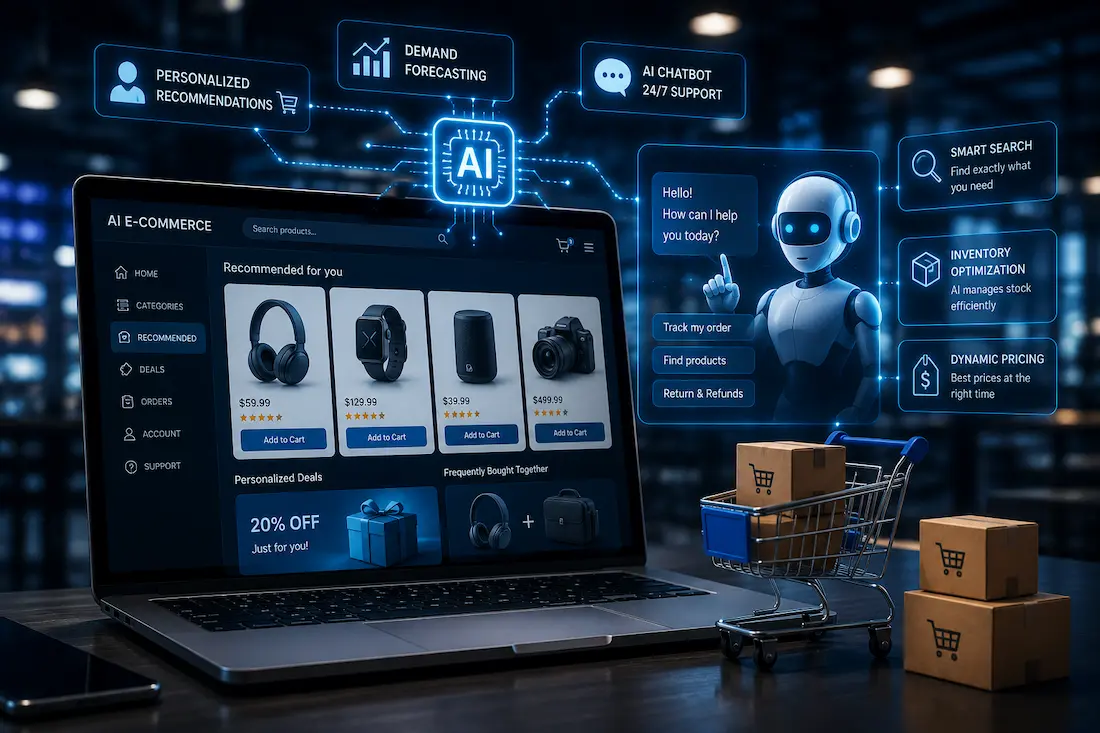
Think of one of those visitors entering your store, spending about 11 seconds in there and leaving without buying anything. Now imagine an invisible assistant that could predict what they wanted to read, display it before they scroll away and convert that visitor into a customer. There is already an assistant for that and it is based on AI in e-commerce.
Indeed, industry surveys indicate that over 80% of retail business leaders today view AI as integral to their continued competitiveness and AI-powered personalization has been found to boost conversion rates by 15% or more in online stores.
In its simplest form, AI in e-commerce is the application of machine learning, chatbots and predictive algorithms to automate processes that used to take whole teams to accomplish, including customer support and product suggestions. This guide takes you through the tools, practical examples and the future of the technology. We’re keeping our eyes on these changes at Aidukes and you don’t need to.
As AI in e-commerce adoption grows across every store size, businesses that ignore it risk falling behind competitors who already personalize every visitor’s journey.
What is AI in E-Commerce?
How AI Is Changing Online Shopping
If you had to do any shopping, it used to be a scroll through endless category pages in the hope that you’ll find something you like. AI turns that experience around.AI turns that around. It analyses the activities of users as they browse and buy and even the movements of their mouse on the computer screen and suggests products that the user is likely to be interested in purchasing, sometimes before he himself even realises he needs them.
A few of the world’s biggest retailers, such as Amazon, already earn a large proportion of their business from their AI-powered recommendations and with cost-effective plug-in tools, smaller businesses can benefit from the same technology.This shift shows exactly why AI in e-commerce is no longer optional for stores that want to stay competitive.
Why Online Stores Are Adopting AI Fast
Speed drives adoption. In recent years, a new report from the industry revealed that artificial intelligence (AI) tools can slash customer response time by almost 70% without increasing support costs.
It is no longer a luxury to have AI for enterprise budgets, as store owners recognize its power. Cloud-based pricing models enable a small Shopify store to run the same recommendation engine as a billion-dollar store but on a much smaller scale. According to McKinsey’s retail research, 78% of organizations have now incorporated AI into at least one business function — up from just 55% in 2023, showing how fast this shift is happening.
This is one of the biggest reasons AI in e-commerce has moved from a nice-to-have to a core operational requirement for online stores of every size.
Top AI Tools for E-Commerce Businesses
The key to selecting the best ai tools for e-commerce is to identify which aspect of your online business needs the most support. Here’s where most brands start.
AI Tools for Product Recommendations
Recommendation engines, powered by AI Productivity Tools, analyse buying trends and immediately propose similar or alternative products. These tools can typically increase the average order value (AOV) of stores by 10-30% just because shoppers find something they didn’t even realize they needed.
AI Chatbots & Customer Support Tools
From managing refunds to tracking orders and answering product questions, Chatbots can now do it all, anytime of the day. More than 60% of businesses claim to handle more than 60% of their simple
AI Tools for Inventory & Demand Forecasting
Forecasting instruments will analyze seasonal trends and buying trends to predict the exact amount of stock you will need. This will stop the two worst inventory pitfalls from happening: selling out of bestsellers and overstocking products that no one is buying.
AI Tools for Content & Ad Copy Generation
The writing of even a few hundred SKUs will consume a lot of time by any small group of people. Artificial Intelligence copywriting programs can now assist the marketing team in composing their descriptions, headlines and writing their emails in mere seconds.
| Tool | Best For | Pricing Tier |
|---|---|---|
| Recommendation Engines | Upselling & cross-selling | Free – Paid tiers |
| AI Chatbots | 24/7 customer support | Free – Mid-range |
| Forecasting Tools | Inventory planning | Mid-range – Enterprise |
| Copy Generators | Product & ad content | Free – Paid tiers |
Best AI Tools for eCommerce in 2026
Not all shops require the same system. The best ai tools for ecommerce in 2026 vary significantly based on the nature and growth stage of the ecommerce businesses utilizing them.
Best for Small Stores
Small and new stores get the most out of lightweight and plug-and-play tools that are easy to set up technically. While a more sophisticated recommendation plugin would be desirable, a chatbot widget is a solid investment that won’t steal too much of the budget.
Best for Enterprise Brands
Brands with more capital can afford to create their own AI models tailored to their own customers’ data, resulting in precision levels that oftentimes are hard to beat. These systems can be seamlessly connected with the existing CRM and stock management systems.
Free vs Paid AI Tools Comparison
Free tools are great for testing an idea, but typically impose a limit on the number of products, conversations or predictions that you can run per month. The paid levels offer greater analytics, faster processing speeds and priority support making it a quick return on investment when sales volume increases.
ChatBots vs Conversational AI: What’s the Difference?
When choosing AI solutions, it’s also important to understand ChatBots vs Conversational AI. Traditional chatbots follow predefined rules and scripted responses, while conversational AI uses natural language processing (NLP) and machine learning to understand context, remember previous interactions, and provide more human-like conversations. Businesses looking to improve customer support and engagement often benefit more from conversational AI than basic chatbots.
Rising for AI-Powered eCommerce Tools Demand
In fact, the curve for AI-powered ecommerce tools demand is expected to continue accelerating into the foreseeable future.
Market Growth & Adoption Trends
According to analysts, the AI in retail market is all set to cross the $40 billion milestone in a matter of years at a growth rate of more than 20%. That growth is a measure of the pace at which all store sizes are incorporating AI into their operations. Independent industry data backs this up — according to Ringly.io’s retail AI research, AI-driven personalization is already boosting average order value by as much as 369% for engaged customers.
Why Businesses Are Investing in AI Now
When ad prices increase and profit margins decrease, store owners must look for ways to be efficient in all areas. AI brings that efficiency by streamlining repetitive tasks and enhancing targeting precision making every marketing dollar count. Shopify’s own data confirms this shift in priorities, with 84% of ecommerce businesses now ranking AI as their top strategic focus for 2026.
What This Means for Store Owners in 2026
Those retailers who play second fiddle will be overtaken by those who provide the personal touch through all forms of interaction. AI for Email Marketing helps create more personalized campaigns, while starting with even one AI tool builds the data foundation needed to make smarter decisions in the future.
How to Choose the Right AI Tool for Your Store
Checklist Before You Buy
- Ensure that it works with your existing platform (Shopify, WooCommerce, Magento).
- Observe the pricing tiers with the volume of your orders and not only with the number of team members.
- Check for a free trial before signing up for an annual subscription
- List the stores that are comparable to your size and read their reviews.
Common Mistakes to Avoid
There are lots of AI tools out there that many store owners purchase and then find themselves lost in a sea of dashboards that no one accesses. Focus on one specific problem, get it solved correctly, and add more tools to your toolkit as you start to see noticeable results. Getting the basics right with AI in e-commerce matters more than chasing every new tool on the market.
Want to go in-depth on tool breakdowns? Learn more about the tools with AI on Aidukes.
Conclusion
AI in e-commerce isn’t just for the big boys who have the deep pockets for extensive technology budgets. No longer is there a shortage of tools that are available to offer stores of all sizes a real competitive advantage, ranging from chatbots to forecasting engines. Brands that try out new things early on often develop the best customer loyalty eventually.
As the next big wave in online retail emerges, continue learning about the newest AI trends and reviews of the newest AI tools by subscribing to Aidukes.
FAQs
Which AI tool is the most suitable for newcomers in the e-commerce industry?
For basic users, it’s best to use simple chatbot widgets and built-in recommendation plugins. They don’t need coding, have free starter plans and produce tangible results in the first few weeks of use.
Does AI make sense for ecommerce small businesses?
Yes, small businesses can reap the greatest benefits because AI can replace human employees to complete jobs faster. One smart tool can make a difference in conversions in a matter of a short trial period.
So, what will AI-powered ecommerce tools look like in the future?
Deeper personalization, voice shopping and AI that predicts trends before they hit peak hotness are all to be expected. Tools will continue to become more affordable and user-friendly, for all stores, regardless of size.
Is customer service staff being replaced by AI?
Not entirely. The repetitive and routine questions are answered by AI, and complex or sensitive questions are handled by human agents. The majority of stores have a combination approach that is a perfect mix of both.
What is the price of an AI e-commerce software?
It is available for free basic plans to a few hundred dollars per month for enterprise-grade or advanced forecasting. Typically, the higher the order volume and depth of features, the higher the price.
 Facebook
 Twitter
 Instagram
 Pinterest





Leave a Reply