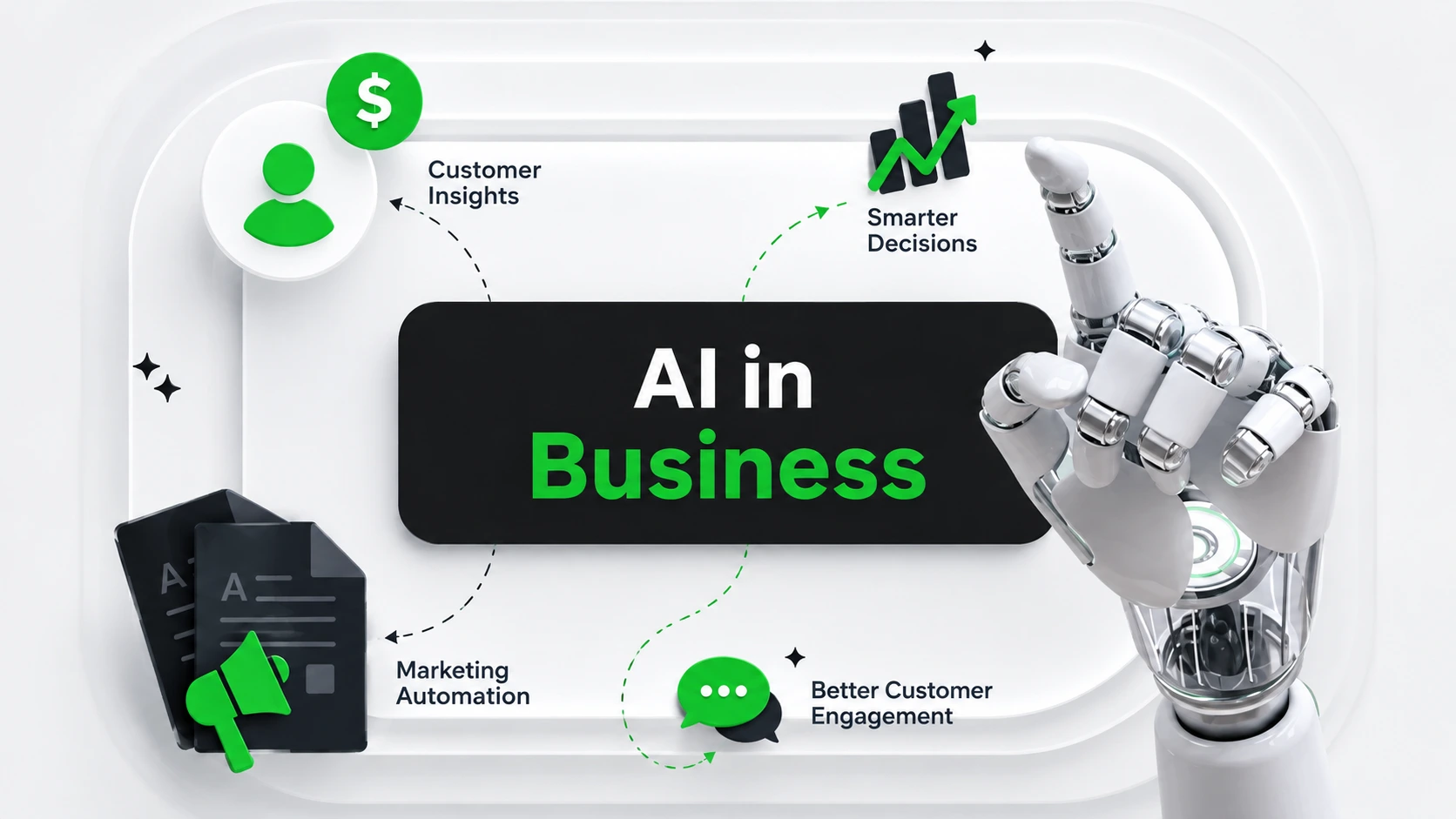
The question isn’t if to use AI for marketing; it’s which use case to tackle. When you see real-life AI in marketing examples, it’s easier to make that decision since the results aren’t just theoretical. According to Salesforce’s State of Marketing 2026 report, 87% of marketers are already leveraging generative AI in at least one recurring workflow, compared to 51% of marketers two years ago.
This guide breaks down real AI in marketing examples, not the hype, across content, ads, SEO and customer service, and helps you recognize which ones can be incorporated into your team.
What Is an AI Marketing Agency?
So, what is an AI marketing agency, anyway? It’s a company that integrates AI into the way they deliver their services, not just the Slack messages about ChatGPT but into strategy, execution and reporting.
Traditional agencies add AI to their current operations. An AI-powered agency optimizes the process itself: Campaign briefs are developed based on performance metrics; ad copy is automatically tested and optimized and reporting dashboards keep things updated in real time, not monthly. Examples of this change are agencies such as OnesLogic, which combine traditional elements of web development and SEO with AI-powered content creation.
It is important to note that this difference is relevant to the buyer. A traditional agency has an hourly charge, while an AI-first agency has begun charging around the outcome, since AI has shaved off many hours from creating the first draft, a media plan or a series of ad variants.
Real AI in Marketing Examples
This is where AI in marketing examples come into play. Here are some of the use cases that are proving impactful in marketing teams today.
1. AI Marketing Cloud Tools
Customer data, email campaign automation and analytics are all integrated through a customer data platform. Examples include Salesforce Marketing Cloud and Adobe Experience Cloud. This helps marketers to send personalized emails, perform lead scoring and journey management without having to integrate five separate tools.
2. AI Performance Marketing Campaigns
AI performance marketing involves machine learning to fine-tune bidding, targeting and creative in real-time. AI-powered campaigns have the potential to generate approximately 22% more ROI than traditional campaigns, according to McKinsey’s Global AI Survey, due to the ability of the system to redirect budget in hours vs. weeks.
3. AI-Driven Organic Marketing and SEO
Today, AI software classifies keywords, makes content outlines and detects SEO issues. The purpose of this is to enable a team to write more often without burdening the human editor with repetitive research.
4. Chatbots and Conversational AI
Ordering and product tracking through customer service chatbots have shrunk the response time from hours to seconds. To dive deeper into their actual applications, read AiDukes’ guide on conversational AI for customer service.
5. Personalization Engines
AI-driven personalization tailors product recommendations, email content and on-site messaging according to individual browsing patterns. Data from McKinsey shows personalization engines deliver around 2.7x ROI, second only to AI content drafting among common use cases.
6. Predictive Analytics
Models predict churn, lifetime value and the performance of campaigns even before the first dollar is invested. These predictions help marketing executives move their money away from failing marketing channels even before quarterly evaluations.
7. AI-Generated Creative and Video
Tools like Meta’s Advantage+ now generate and test ad creative variants automatically. Meta’s AI-driven ad system has surpassed a $20 billion annual revenue run rate with generated creatives showing a 47% lift in click-through rate over manually built versions.
Pros and Cons of AI in Marketing
The pros and cons of these AI in marketing examples matter more than the adoption numbers themselves.. There is a real difference in weight on each side for teams considering how far to go.
Pros:
- Faster content production and campaign turnaround
- Lower cost per acquisition through real-time optimization
- Deeper personalization at a scale humans can’t match manually
- Predictive insights that catch problems before they show up in results
Cons:
- Over-reliance risks generic, low-differentiation content
- Training gaps persist — most marketers still receive no formal AI training from employers
- Consumer trust remains a challenge, with only about a quarter of consumers saying they trust brands to use AI responsibly
- Junior roles focused on repetitive tasks are shrinking as automation expands
The takeaway isn’t “use AI everywhere” or “avoid it entirely.” It’s matching the tool to the task and keeping a human editor in the loop for anything customer-facing or brand-defining.
AI Marketing Cloud: Leading Platforms
An AI marketing cloud is one of the most widely used AI in marketing examples — a single place to manage customer information, create content and automate campaigns, rather than a collection of disjointed applications.
- Salesforce Marketing Cloud — strong for enterprise CRM integration and predictive audience segmentation.
- Adobe Experience Cloud — built for teams that need deep content personalization across web, email, and mobile.
- HubSpot Marketing Hub — a lighter-weight option well suited to mid-market teams that want automation without an enterprise price tag.
The decision of which platform to use typically depends on the existing tech stack and data maturity. The AI features are more likely to pay off for teams with clean CRM data than those with fragmented data, as the latter would need a data cleanup project to reap benefits from the aforementioned clouds. These platforms are always evolving and it’s important to keep an eye on technology publications such as DailyTechify which keep a close eye on these platforms.
AI and Organic Marketing: How It’s Changing SEO
The most obvious areas of overlap between AI and organic marketing are content creation and search optimization. With AI Overviews on about 48% of the queries, being included in a traditional blue link is no longer the only goal; being mentioned within an AI-generated answer counts just as much.
This is a change in the definition of “good SEO content. AI search results tend to favor clear content that has well-organized data and comes from a well-established and trusted website with a robust backlink profile. Even niche B2B brands are adapting: companies like Vexa Packaging, for instance, are reworking product pages with clear headings and direct answers to drive AI-driven organic traffic.
In practice, it’s a shorter more direct answer towards the top of a page with supporting detail below as opposed to the long, winding introduction that was previously used to fill up word count for search engines.
The Future of Marketing with AI
The next wave of AI in marketing examples points toward agentic systems that generate content and also carry out entire campaigns with minimal human involvement. Nearly one-third of enterprise marketing teams already have at least one autonomous agent in production and this figure will grow by 2027.
There are three trends to monitor in the next 18 months:
Agentic campaign management — AI systems that create, launch and fine-tune campaigns under the human guidance of an agent but don’t execute campaigns.
An AI-native search experience — increased discovery within chat pages, not search results pages.
Realignment of roles — less demand for junior roles that execute day-to-day tasks and more demand for roles that manage AI systems and identify errors.
All this does not substitute for marketing sense. It moves the point of application of that judgment from production to oversight.
Conclusion
What they all have in common is that their success happens when they are implemented at scale but a human is still in charge of the strategy. They all rely on the fact that they’re successful when a person is still in control of the strategy and the AI system executes it on a large scale. AI can only enhance strategy not replace it or else you’ll get a forgettable job done; AI can only accelerate and speed up or else you will outdo your competitors on speed and cost.
Desire to learn more about the tools themselves? Check out AiDukes‘ complete listing of the best AI tools for business or contrast AI tools side-by-side in our guide on ChatGPT Plus vs. Claude Pro. Sign up for AiDukes for additional AI marketing breakdowns as the space continues to evolve.
 Facebook
 Twitter
 Instagram
 Pinterest



Leave a Reply