
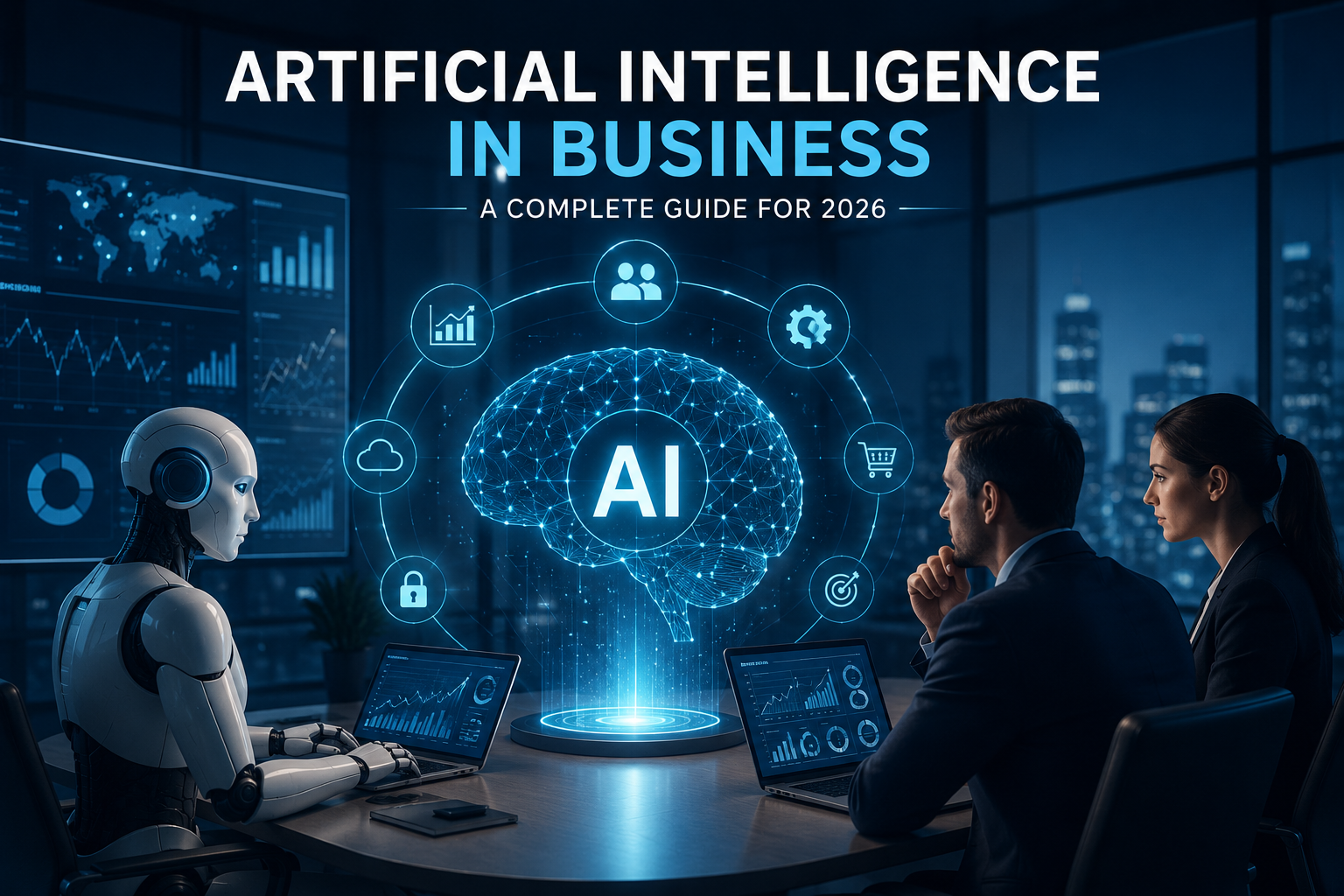
The concept of artificial intelligence in business is no longer a distant dream but a reality in the here and now. No longer is the debate whether organizations should adopt AI but rather how fast can they do so. No longer is the issue whether organizations should embrace AI but how soon can they accomplish this.
The trend is affecting all industries today. Retailers forecast demand as if it were made of crystal, hospitals detect diseases in time and banks prevent fraud from emptying a single account. Retailers foresee demand more accurately, hospitals detect diseases in time, and banks prevent fraud from emptying a single account. Leaders in all industries invest in AI due to its proven, measurable impact.
Here’s what you need to know, all explained in this guide. You will understand the meaning of AI in the world of business and how it works in the background, which businesses can benefit most and how your business can get started without wasting your time and money. Aidukes created this guide for you to have a no-nonsense roadmap for 2026 and beyond.
What Is Artificial Intelligence in Business?
Artificial Intelligence for Business is all about the use of AI systems to analyze data, detect patterns, and then take decisions or predictions that would otherwise have been made by humans before.These systems are not based on a set of rules but rather learn as they go.
Today AI is relevant because human ability can’t deal with the volume of data. In one day, companies create more information than departments could process in a year. AI systems are able to sift through that noise, identify the patterns that are significant and provide a signal rather than noise to decision makers.
Now, AI is being embraced by businesses of all sizes and industries.From the recently conducted study in the industry, it was discovered that 91% of all companies have integrated artificial intelligence in some form within their organizations in 2026 compared to only 78% in the previous two years. This clearly demonstrates that artificial intelligence is not solely reserved for the IT industry but is being applied by small companies as well as individual entrepreneurs.
AI in Business: Why It Matters
The significance of AI in business is driven by its impact on decision-making economics. Leaders used to depend on quarterly reports and being “on the ball. Now they access real-time dashboards, which refresh every minute and alert them to issues that could prove costly.
Adoption figures continue to rise quarter by quarter and the trend appears to be continuing. In 2025, use of AI in enterprises increased by about 10% points from 2024, while the usage of generative AI has nearly doubled since 2023. In the past, companies were using AI experiments but today they create entire departments in the name of AI.
There are some business trends that drive this acceleration on.There are a number of business trends that push this acceleration along. Coordinated teams are essential for remote and hybrid teams. There is an expectation of instant response at any time. Real-time visibility is required in supply chains. AI fulfills all three demands all in one, hence its position in the middle of all digital transformation solutions today.
AI acts as a digital transformation agent since it has an influence on all functional areas simultaneously. This is because the marketing department makes personalized campaigns, the finance department makes automatic reconciliations and the HR department can analyze résumés in seconds. Put differently, there is no other technology that affects so many departments at once.
How Artificial Intelligence for Business Works
There are several key technologies that are essential to artificial intelligence for business. Each one will give you insight into which tools are best for your business’s objectives.
Machine Learning
Machine learning programs algorithms with past data, enabling them to detect patterns and forecast results. It can be used by retailers to predict which products will sell out and by lenders to determine credit risk in seconds not days.
Natural Language Processing (NLP)
NLP allows the computer to read, interpret and generate human language. In the business world, it is used to enable chatbots to have intelligent conversations, to summarize contracts, to analyze thousands of customer reviews in minutes among other applications.
Computer Vision
Computer vision technology allows computers to make sense of what is seen in images and videos. It is used by manufacturers for detecting defects during the production process in the assembly line and by retail outlets for keeping track of their inventory without actually counting anything.
Predictive Analytics
Predictive analytics is a mix of statistics and machine learning that predicts future events. Airlines forecast maintenance requirements before parts fail and marketers forecast leads that will convert before a sales person calls.
Generative AI
Generative AI creates content based on a prompt provided and using a database for training purposes. The rate at which organizations adopted the use of generative AI increased from 33% in 2023 to 71% in 2024, making it the fastest business technology adopted within recent times.
AI Automation
AI automation connects several AI technologies to form a workflow that does not involve any human intervention. The invoices can be processed, tickets can be assigned, and reports can be prepared in an automated way, thus enabling people to work on other activities.
Benefits of AI in Business
The benefits of AI in business reach well past just saving money. Organizations that strategically implement AI enjoy concrete advantages in nearly all areas of their operations.
- Enhance efficiency: Employees handle routine tasks in much less time, freeing up hours for strategic initiatives. Research indicates that AI can enhance employee productivity by as much as 40%.
- Cost savings: Automation reduces costs through the elimination of labor and expensive mistakes in finance, logistics and customer service.
- Better customer experiences: AI can provide a more tailored approach for every customer, ranging from product recommendations to customer service interactions, something difficult to accomplish manually and challenging to scale.
- Faster decision-making: Rather than having to wait for quarterly reviews, real-time dashboards enable leaders to make decisions based on new information.
- Workflow automation: AI does the data entry, scheduling and approvals without a human touch, significantly reducing turnaround time.
- Personalized marketing: AI serves as an effective instrument for dividing audiences, producing messages that connect with them more successfully than any alternative approach.
- Improved operational efficiency: Organizations leveraging generative AI are experiencing a 3.7x return on investment, suggesting that gains in efficiency directly influence profitability.
AI Business Solutions for Different Industries
While the application of AI business solutions can vary by industry, each sector discovers a means to get a measurable return on investment from the technology.
Retail
AI helps retailers predict consumer demand, provide individual product suggestions, and optimize stock levels in real-time, thus minimizing both overstocking and stockout scenarios.
Healthcare
AI is used in hospitals to scan patients, identify those at risk and simplify administrative tasks. Over 80% of hospitals are implementing AI in one or more clinical or operational areas.Over 80% of hospitals are utilizing AI in one or more clinical or operational roles.
Finance
Artificial intelligence is used by banks and insurers to detect fraud, credit score and algorithmic trading. Financial services companies are at the forefront of all industries in AI deployment and almost half of banking and insurance companies are currently operating AI agents in real-time.
Manufacturing
Computer vision and predictive maintenance are employed in manufacturing facilities to identify problems with machinery and products that can prevent production due to narrow margins of profit.
Education
Learning institutions and training facilities make use of AI technology to customize the learning process, assessment of tasks and learners who require additional support before they lag behind.
Logistics & Supply Chain
Artificial intelligence is applied in logistics to streamline the delivery path, anticipate shipment delays and control the robotics in warehouses, cutting days off delivery schedules.
Real Estate
Real-estate companies apply AI to price housing precisely, pair customers with offerings and automate following leads to ensure that agents make deals more quickly.
Customer Service
Support teams use AI chatbots and virtual agents to solve simple tickets in real-time, leaving the more complicated ones which really require human interaction to be escalated.
Common AI Applications in Business
The typical applications of AI are literally across the board and the majority of businesses are already using many of them without being aware of the extent to which AI permeates the daily operations of the company.
- AIatbots to respond to customers around the clock.
- Robots to arrange meetings and inboxes.
- Sales forecasting systems that are much more precise forecasts of revenue.
- Marketing automation tools that initiate campaigns according to user activity.
- Systems that alert of fraudulent transactions immediately.
- Real-time inventory management systems.
- Human Resources and Recruitment Software Screening Resumes and Arranging Interviews
- Business intelligence dashboards transforming raw data into understandings.
- Copywriters, image and video generation tools that write copy in minutes.
Real-World Examples of AI in Business
Important real-life examples can demonstrate that AI provides the results far beyond the theory. Firms of all size segments are already reporting specific victories.
- Automation of customer support: customer support automation reduces response time that would have taken hours to seconds with AI customer support agents.
- Individualized recommendations: e-commerce sites generate a large portion of revenue by using AI-generated product recommendations.
- Maintenance through prediction: equipment manufacturers avoid costly maintenance downtime by fixing the equipment before breakdown.
- Financial risk assessment: banks analyze financial risks of borrowers within seconds instead of days.
- Demand forecasting: retailers match inventory with real customer demand, minimize wastage and markdowns.
- Analytics through artificial intelligence: the management gets performance metrics real time and not monthly.
How to Implement AI in Your Business
Implementing AI successfully takes more than buying software. Adhere to a systematic procedure to prevent wastage of money and stagnation of projects.
Identify Business Goals
Begin with identifying the problem you wish AI to address, be it reducing response time, lowering cost or raising the sales conversion.
Select the appropriate AI tools
Align match tools with your objectives and current technology stack and not with the latest fad. The appropriate platform will fit well with what your team is already using.
Prepare Your Data
Fresh, well-organized data is the key to the success of your AI system or its failure. Check the sources of your data and seal gaps before any model opens.
Train Your Team
Employees require practical training to be able to use AI tools. The most notable obstacle to adoption is skills gaps and education is best funded at an early stage.
Measure Performance
Measure improvements in tracking metrics on day one, like time saved, reduced error or increased revenue to be able to demonstrate ROI and justify subsequent investment.
Scale AI Across Operations
When a pilot has demonstrated its worth, extend the same strategy to other departments. The key difference between successful scaling companies and those that fail to scale is that the former focus the majority of their effort on people and processes, not merely the algorithm itself.
Challenges of Using AI in Business
The difficulty of AI usage is something that deserves to be given equal attention as the advantages. Intelligent leaders anticipate such hindrances and preclude them before they bring down a project.
- Data privacy and security: businesses need to secure sensitive customer data because AI systems will process more data.
- High implementation costs: even with sophisticated AI tools and talented staff, many companies have a hefty initial cost to cover.
- Integration with existing systems: legacy software may not easily integrate with new AI platforms.
- Employee training: teams require resources and time to develop true AI fluency, not simple familiarity.
- Ethical concerns: firms need to establish bright boundaries on the decisions that AI makes that have an impact on actual individuals.
- AI bias: the models that are not trained properly may reproduce or enhance the historical data biases.
- Regulatory compliance: companies have to monitor the changing regulations of AI in all the regions they are operating.
Best AI Tools for Businesses
The optimal AI tools will depend on your particular application, though most companies construct their stack out of few trusted types.
- AI writing aids that compose marketing text, emails, and reports.
- Automated ticket resolution customer support.
- AI scoring and forecasting CRM systems.
- Scaling of campaigns with marketing automation.
- Data analytics tools that convert raw data into actionable dashboards.
- AI code generators that accelerate the process of software creation.
Future of Artificial Intelligence in Business
In the coming years, the implementation of artificial intelligence in business processes will gain even more significance. Tomorrow belongs to those who prepare today.
- Multi-step task execution by AI agents with minimal human interference.
- Process flows that can be executed independently.
- One-on-one personalized interactions with every customer touchpoint.
- Predictive business intelligence that anticipates problems before they surface
- Artificial intelligence-based decisions built into leader boards.
- Trends for the future: 2026 and beyond. AI regulations and the expansion of AI among small businesses.
Conclusion
The idea of artificial intelligence in business is no longer a far off trend, it is a way in which businesses compete, serve customers and grow in 2026. Companies that integrate AI in a strategic manner lead the pack and those that are slow in doing so are likely to be left behind.
Implement AI deliberately, not in a frenzy. The rules are to set clear objectives, select tools that match your actual needs and train your team adequately, prior to scaling. The firms that view AI as an extended ability, rather than a fast solution, reap the largest benefits.
Aidukes invites all readers to consider AI solutions on the basis of actual business objectives. Begin small, quantify it all, and develop toward a time when AI assists your team, rather than the judgment. The companies that make a move will outline the future of growth in the next decade.
FAQs
What is artificial intelligence in business?
Artificial intelligence in business is a category of software designed to analyze data, acquire patterns and make predictions or decisions that aid the activities of the company, including customer service and supply chain planning.
What is the use of AI in business?
There are dozens of applications of AI in companies in chatbots, fraud detection, demand forecasting, marketing personalization and workflow automation among many more in almost every department.
What are the benefits of AI in business?
AI enhances efficiency, reduces expenditure, enhances consumer experiences, accelerates the decision-making process and generates quantifiable returns where organizations have estimated a 3.7 fold increase in its investment.
Which industries benefit the most from AI?
Finance, health, retail and manufacturing are the areas with the most returns presently but all areas are now discovering practical uses of AI at some level.
What are AI business solutions?
AI business solutions are software applications and platforms, including chatbots, analytics dashboard and automation that use AI to address certain operational challenges.
 Facebook
 Twitter
 Instagram
 Pinterest




Leave a Reply