
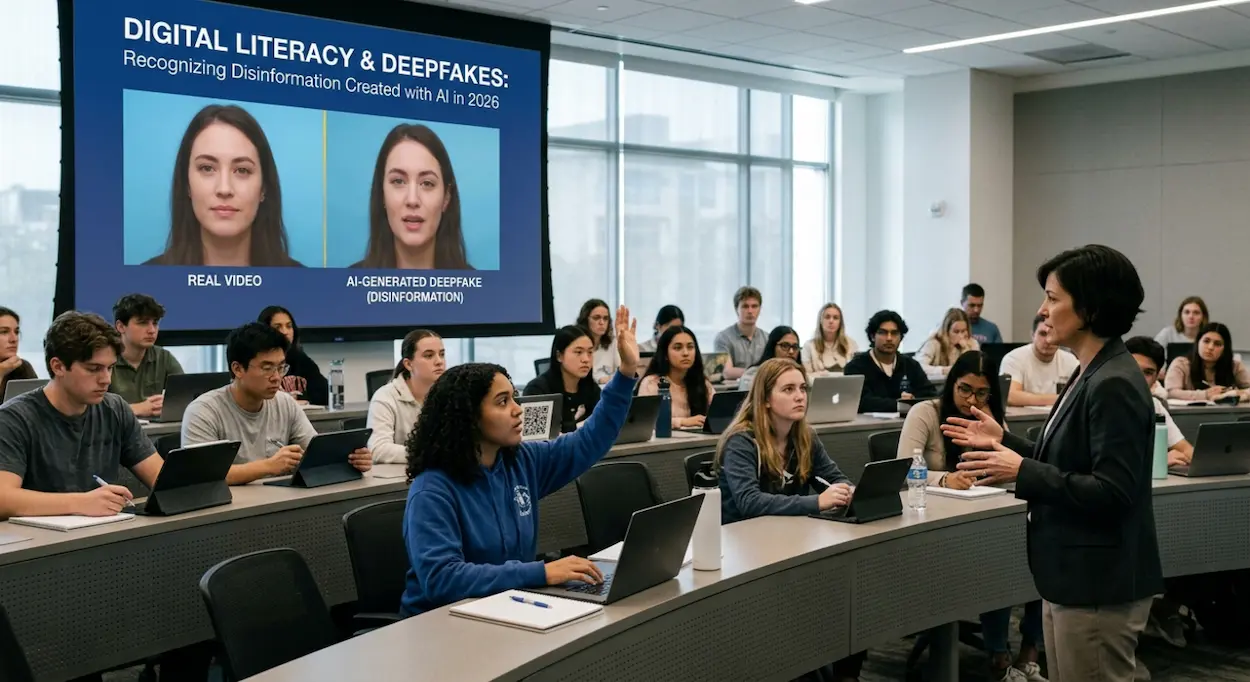
Browse any social feed nowadays and you are most likely to be confronted with a video, voice recording, or image that is not real despite its appearance and sound being utterly convincing. Deepfakes are no longer a tech-demo wonder, but a real disinformation issue, one that can affect us all, whether it is social media teenagers or retirees getting random phone calls. Creating digital literacy regarding deepfakes is no longer a choice, but a survival tactic on the web.
This guide will divide deepfakes, why misinformation is spreading so quickly, which age groups are most at risk and how you, as an individual or a parent or a teacher can develop the skills to tell the difference between real and fake.
What Is a Deepfake? Understanding the Basics of Digital Literacy
Fundamentally, a deepfake is a fake media video, audio, or images that are produced or altered by an AI to create the impression that someone said or did something that they did not. It is a portmanteau of the AI method that it relies on, deep learning, and fake, and encompasses all types of face-swapped videos and AI-generated voices used in scam calls.
Digital literacy in this case refers to the applied ability to assess, skeptically and critically scrutinize the media you come across on the Internet instead of accepting it at face value. It is the contemporary spin on the old-fashioned media literacy, intended to fit in a world where seeing is not believing.
How Deepfake Technology Works
Most deepfakes are made without getting too technical, often with generative AI models that have been trained on massive amounts of images, video or audio of a real person. The model picks up tendencies in the facial movements, voice tone or speech style of someone and creates new content based on the tendencies that it convincingly recreate. Where it might have taken Hollywood-level visual effects budgets can now be achieved using consumer AI tools and a small amount of source material – sometimes only a few seconds of someone speaking.
Deepfakes vs. Traditional Photoshopped Content What’s Different
Photoshopped photos are not new, but they have one thing in common, they are not dynamic and one needs to be a skilled artist to have them. There are three ways in which deepfakes are different:
- It takes a few minutes: not hours, to create credible fake video or audio with the help of speed AI tools.
- Scale: The technology can be applied to produce fake content, not simply edit one image, in mass production.
- Motion Deepfakes: mimic motion, speech rhythm and expression which is much more difficult to detect by the human eye compared to a fixed altered image.
It is precisely this blend that makes digital literacy on deepfakes to be approached differently, and not just as an extension of lessons on how to identify a poor Photoshop job.
Deepfake News and Disinformation Why It’s a Growing Problem
The essence of deepfakes is a kind of disinformation that is aimed at causing deception. The fact that deepfake news seems like a natural addition to the current information consumption habits of people, fast and conveniently on a mobile device, and usually without the need to even pause and check the origin of the information, is what makes it especially dangerous.
How Deepfake Media Spreads Faster Than Fact-Checkers Can Respond
The more common is the illusionary truth effect, which has long been noted by disinformation researchers: the more people are exposed to a piece of fake content, the more believable it becomes to them, including the participants who know better. Deepfakes contribute to this effect even faster since they can be shared by default: a viral video clip disseminates through group chats and social media long before a fact-checking agency gets the opportunity to fact-check it.
By the time a correction or debunk is issued, the original fake has frequently spread to many more people than the correction will ever do such a task, a long-studied phenomenon in the field of misinformation in general, which deepfakes exacerbates because of its emotional and visual appeal.
Real-World Examples of Deepfake News
A well-known example of this in the corporate security industry relates to a finance worker at the Hong Kong engineering firm Arup, who was duped into relinquishing over $25 million once they entered a video conference in which all other participants on the call, such as the person who looked to be the CFO of the company, were AI-generated deepfakes. It is now a popular case study of how believable real-time deepfake video calls are today, and how even trained specialists can fall prey when both graphics and sound are presented as authentic.
In smaller scale, political disinformation has also been perpetrated via AI-generated robocalls that impersonate public figures, such as a highly publicized example of a cloned voice used to dishearten voter turnout before a U.S. primary election. These illustrations highlight an easy fact that deepfake disinformation is not a potential threat but already affecting actual financial and political consequences.
What Age Groups Are Most Affected by AI Misinformation?
Not all people are susceptible to deepfakes equally, and these diversities are the key to creating the appropriate digital literacy approach to each audience.
Teens and Young Adults Exposure Through Social Media
Adolescents devote much of their time to platforms where synthetic content is shared virally, and recent studies indicate a considerable portion of adolescents have already been directly targeted by deep fake content, such as non-consent synthetic imagery. Although raised as digital natives, the intensive use of a platform does not necessarily lead to a high level of verification behavior; most teenagers say they understand how harmful deepfakes can be, yet they are not always able to stop themselves sharing dubious material at the moment.
Adults 35 and 54 Primary Targets for Financial Deepfake Scams
The age group is most often targeted by AI-driven financial scams, such as cloned-voice calls purporting to be a desperate relative or a company official requesting an urgent wire transfer. This group tends to have more financial accountability and authority in the organizations, and it is why they are a favorable target of deep fake audio and video scammers in business email compromise-type of attacks.
Older Adults (55+) Lowest Awareness, Highest Vulnerability
The most significant awareness gaps may be observed in older adults. Research has discovered that a significant proportion of individuals aged 55,64, and even a higher percentage who are 65 and above, report never hearing the word deepfake before being questioned. Meanwhile, this group is likely to record the greatest rates of concern regarding the issue of disinformation when they realize that it is a combination of poor awareness and high susceptibility that predisposes this demographic to targeted education in particular.
| Age Group | Primary Risk | Awareness Level |
| Teens (13,17) | Unconsented images, peer coercion to post. | Intermediate high exposure, irregular checking behaviour. |
| Adults 35,54 | Through imitated voice/video, financial and business frauds. | Moderate aware of risk, low confidence in detection. |
| Adults 55+ | Fraudulent phone calls, misinformation in posts, lack of knowledge about the technology. | Deepfake is a term that has never been heard by many. |
The conclusion: no particular age group is resistant, and each needs slightly different approach to digital literacy, depending on which aspects of deepfakes they experience in their everyday life.
How to Build Digital Literacy Skills to Spot Deepfakes
The embarrassing fact is that detection of high-quality deepfakes by human beings is poor uniformly research after research has indicated that detection accuracy is consistently much lower than what most individuals believe about themselves. This is precisely the reason why using intuition is not a good plan. Habits of systematic verification are much more important than gut feeling.
5 Practical Signs of a Deepfake Video or Image
- Artificial eye movement or blinking AI models are yet to be able to recreate natural blink patterns every time.
- Synchronizations of audio with mouth movements that do not match, and in particular with consonant sounds.
- Uneven lighting or shadows especially in the corners of a face or at the points where the face meets the hair and the background.
- Flat or repetitive facial expression authentic emotion is likely to have to do with micro-movements that AI would struggle to convincingly imitate.
- Slightly unnatural pacing of the audio, absence of breath sounds or flat affect of voice imitation.
Verification Tools and Techniques
High-quality deepfakes cannot be identified with visual inspection alone. Combining observation with verification tools can be used to a great effect in improving detection accuracy:
- Reverse image search (Google Lens, TinEye) to trace back the initial appearance of an image or a frame from a video on the web.
- Software for analyzing frames in videos (InVID), that can detect encoding inconsistencies, upload time and metadata errors.
- Checking the authenticity of a source by visiting the trusted news website or verified account directly, rather than by looking at the screenshot or video re-posted by others.
Developing a Pause-Verify-Share Habit
One effective digital literacy habit alone: a mere pause before posting: inquire about the source of the content, whether the source is factual and whether the statement is intended to cause a strong emotional response. Disinformation deepfake or any other is normally designed to invoke anger, fear, or sense of urgency because these emotions make us act without verification.
Deepfake Disinformation Literacy Lesson Plan for Educators and Parents
It does not need a complete curriculum change to teach deepfake awareness. It is most effectively incorporated into lessons that teachers are already delivering – media literacy, digital citizenship, history, or even science lessons that use the lesson to evaluate evidence.
Structure of the Lesson Plan (Grades 6, 12 and adaptable)
1. Introduction (10 minutes) What are deepfakes and disinformation and what are their simple definitions? Present one of the obvious examples of a deepfake (a famous educational demonstration) to define what students are dealing with.
2. Guided Observation (15 minutes) Walk through 2-3 short video clips as a class – a combination of real and synthetic – and have students observe visual and audio cues and then say what each one is.
3. Verification Practice (20 min) Introduce one type of verification technique, such as reverse image search, and let the students apply this technique to a selected image/video frame in groups.
4. Discussion (10 min) Discussion on the reasons why deepfakes go viral and the role individuals have before posting the content they do not know for sure.
5. Reflection/Assessment (5 min) Short worksheet or exit ticket question: Two aspects you will consider before posting an unbelievable video online?
Classroom Activities to Teach Deepfake Detection
- Real- vs- fake sorting task with an edited collection of short video clips.
- Students of reverse-engineering assignment create their own spot the fake quiz to be given to classmates based on confirmed examples.
- The discussion of the case study with a well-documented deepfake incident (e.g., a corporate fraud case) to explain the implications in real life.
Free Downloadable Checklist
The following checklist is a one-page handout that would be a good printable in-classroom handout or a quick-reference guide that a parent could use at home to discuss the five signs of detection and three verification tools mentioned above.
Conclusion: Staying Ahead in the Age of AI Disinformation
Deepfakes are not leaving us, on the contrary, the technology is getting more available each year and more believable. However, digital literacy is not about the profession of a professional fact-checker. It is about making little, regular habits: taking a moment to pause before posting, finding a second source, and realizing that a video or voice recording is no longer evidence that something has occurred.
It doesn’t matter whether you are a person who has to avoid falling prey to a scam call, one who is discussing with their teenager what they are viewing online or a teacher who is developing this into their classroom, the idea is the same: you need to stay curious and a little skeptical in a media world where seeing is believing can no longer be trusted as a rule.
Want to know about other ways AI is transforming daily life, such as the spread of misinformation via automation or the future of prompt engineering and its effect on interacting with AI-powered devices? Read more of our AI-related guides on the blog.
FAQs
What is the difference between disinformation and misinformation in deepfakes?
Misinformation is the falsely disseminated information with no intention to lie to a person- somebody really thinks it is the truth. Disinformation is misleading information that has been produced and distributed intentionally in order to deceive individuals. The majority of deepfakes belong to the disinformation category as they are created with the purpose of making a person think that something or someone fake happened or was said.
What is the age bracket that is likely to succumb to AI-created fake news?
The studies identify older individuals, especially those who are 55 years and older, as the most unaware of deepfakes and the most challenged by them in terms of being able to differentiate between original and fake content. Nevertheless, younger viewers are not the least affected, especially in the case of non-consenting synthetic images that are spread on social media, and they are susceptible not only to age.
What are schools supposed to do to impart serious media literacy around deepfakes without frightening students?
The best strategy is to develop practical skills and not fear. Lesson framing (around curiosity and verification, as in here is how you check instigued by how scary this is) can make students feel prepared instead of scared. Lessons are also constructive by use of age-related, clearly marked examples (as opposed to real, which may be disturbing).
 Facebook
 Twitter
 Instagram
 Pinterest





Leave a Reply