
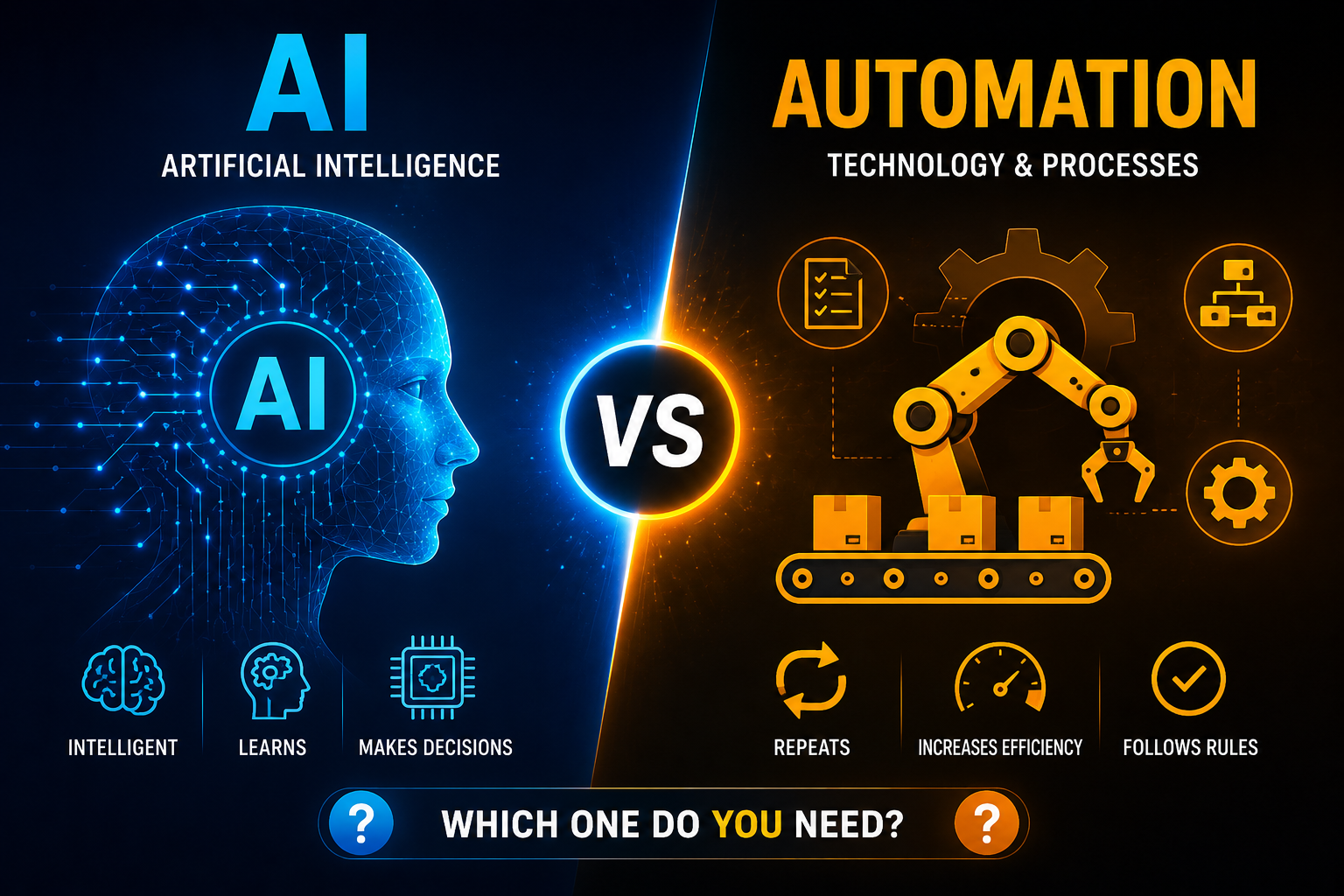
And when you find yourself typing AI vs automation into Google at 11 PM in an attempt to determine which of the two your business really requires you are not alone. The two terms are used interchangeably in marketing decks, LinkedIn posts and vendor pitch but they are not similar.
Recently we collaborated with a middle-sized logistical company that had been developing rule-based automation to its order-processing workflow. It succeeded until the volume of orders tripled and exceptions began to fall through. More automation was not the solution. It was applying artificial intelligence to it. The single shift reduced the time of exception-handling of manuals by about 40%.
In a single story, that is the true difference between AI and automation: automation does as you tell it. AI determines the rules to be.
We will dissect in this guide how AI and automation are different, the source of automatization vs automation confusion, how to gauge automation efficiency and how to determine which one (or both) your business actually requires.
What Is Auto mation?
Automation refers to the employment of technological means to carry out routine, rule-based processes without any human involvement. It is preset and takes action when X occurs, do Y. No education, no opinion, no going off the track.
The horse of efficiency in operations is automation. It doesn’t get fatigued, doesn’t require coffee breaks, and doesn’t commit typing errors. But neither does it think.
How Traditional Automation Works
Classical automation consists of conditional logic: a program of fixed rules of the form of an if-then. The example of a factory conveyor belt sensor that halts the conveyor in case something comes in its path, or an email autoresponder that replies identically when someone emails support@.
Classical automation consists of conditional logic: a program of fixed rules of the form of an if-then. The example of a factory conveyor belt sensor that halts the conveyor in case something comes in its path, or an email autoresponder that replies identically when someone emails support@.
In relation to the work of McKinsey, the majority of jobs will not be eliminated altogether due to automation but rather large portions of them will be transformed. Their initial 2017 research concluded that approximately 60% of occupations have at least 30% of their day to duty that might be mechanized, and less than 5% of occupations might be completely mechanized. That is, not that robots are going to take away entire jobs, but that machines will perform certain repetitive tasks in a job, liberating individuals to perform other work. Those figures have been further increased in November 2025, as McKinsey estimated that 57% of the work hours in the U.S. could now be automated with already available technology that demonstrates how quickly this ability has expanded in a few brief years.
Key traits of traditional automation:
- Works based on a set of rules.
- Cannot adapt to new or unexpected inputs
- Needs to be reprogrammed manually to modify behavior.
- Good at lots of repetitive structured tasks.
Common Examples of Automation in Business
- Drip campaigns and email autoresponders.
- Generation of an invoice based on a sale made.
- Scheduling payroll based on a schedule.
- Robotics on assembly-lines repeating the same physical action.
- RPA Robotic Process Automation Data entry bots that transport information between systems to systems.
However, if the process is repetitive and there are no changes in the rules, it may be sufficient for the task to be automated.
Definition of Artificial Intelligence
Artificial intelligence refers to an intelligent machine or software program that makes decisions and predictions based on learning from the data, recognizing patterns in the data without programming. In comparison to automation, AI is capable of handling uncertainty.
This is where AI and automation begin to separate in terms of ability. Automation brings up the issue of what rules should be used, but AI queries how information is guided in that particular situation.
How does AI differ from the rule-based systems?
Rule-based system breaks when it comes across situations which are outside its programming. In contrast to AI, the latter is designed to generalize. A machine learning model based on thousands of customer support tickets can classify a ticket it has never encountered, not by a hard rule, but by the pattern that it has learned.
| Capability | Rule-Based Automation | AI |
| Handles new/unseen scenarios | No | Yes |
| Seeks to learn over time. | No | Yes |
| Needs reprogramming in order to fit. | Yes | Rarely |
| Makes probabilistic decisions | No | Yes |
Examples of AI Applications in Businesses
- Natural Language Understanding Chatbots that are dependent upon the comprehension of natural language and intent.
- Recommendation Systems like those used by Netflix and Amazon.
- Tools for detecting fraud, pointing out suspicious transaction patterns.
- Predictive Maintenance to predict when an equipment will break down.
- Demand Forecasting using AI
Artificial intelligence and automation are not in a competitive relationship, but rather stratified. AI frequently gives the thought that determines what and how to automate.
AI vs Automation: The Core Differences artificial intelligence and automation
Having now defined the two, we will compare them point-blank over the factors that do count to a business decision.
Decision-Making Capability
Automation carries out decisions that have been made and programmed in rules by humans. Decision making is done according to patterns within the data, which is often real time and may take into account probabilities as opposed to a single fixed path which is the case with AI.
Learning & Adaptability
This is the only major distinguishing factor. Automation is fixed at this point in time it will do what it did on day one unless a human alters the code. AI can evolve; a great deal of AI systems become more accurate with time as they receive additional data.
Data Dependency
Automation requires an organized input to activate a rule (a form field, a timestamp, a change in status). To train and refine its models, AI requires data at scale, which is sometimes messy, and vast. Bad data will paralyze an AI system to such a degree that it does not do that to simple automation.
Cost & Implementation Complexity
Most technologies are no-code/low-code and therefore cheaper and faster to automate. Automation through AI, however, is comparatively more expensive to set up initially because of the cost of setting up data pipelines, training or purchasing models and drift detection.
AI vs Automation at a Glance
| Factor | Automation | AI |
| How it works | Follows fixed rules | Gather information based on statistics. |
| Adaptability | Manual updates of low needs. | High is better with time. |
| Best for | Repetitive, structured tasks | Judgment, variable, complex tasks. |
| Setup cost | Lower | Higher (data + training) |
| Examples | Email triggers, invoice bots. | Chatbots, fraud detection, forecasting. |
| Handles exceptions | Poorly | Well |
Automatization vs Automation: Clearing Up the Confusion
A fast yet frequent search: automatization vs automation.The easy way out is that there really isn’t any difference at all.
While automatization is just one of the synonyms of automation which is used rarely and has grammatical antiquity of the form; the direct translation of the word in certain European languages is automatization (Spanish automatisation, French automatisation).
Automation is currently the widely used term in business and technology literature, while automatization does not describe some other concept or technology, it is just an uncommon synonym. Each time both are used in one article, they refer to the same thing.
Intelligent Automation: How Do Artificial Intelligence and Automation Work Together?
In no way do top companies apply either AI or automation individually.Despite all of this, they use both these methods simultaneously, and this method is termed intelligent process automation (IPA).
What is Intelligent Process Automation (IPA)?
The intelligent process automation (IPA) process is an integration of the advantages of conventional automation methods such as robotic process automation (RPA) along with the capability of AI in finding patterns and decision-making. Simply put, the computer is programmed to execute a specific process over and over again and solve any exceptions on its own.
Example: a conventional automation is capable of extracting the data from an invoice. Nevertheless, in case there are some unusual formats or numbers on it, the additional AI layer will be able to detect it, recognize the problem and route the invoice to the right person without any rules created by humans beforehand.
Real-life examples of business applications for automation driven by AI
- Customer service: automation of ticket routing and prioritization due to AI-based analysis of customer mood/sentiment.
- Finance: transaction entry automation and detection of fraudulent/anomalous transactions through AI.
- HR: resume intake automation + candidate selection and prioritization based on AI.
E-commerce: Automated order fulfilment (automation) + AI-based personalized product recommendations.
This is where the term artificial intelligence and automation ceases to be a comparative and becomes an alliance.
How to Improve Automation Efficiency With AI
Automation efficiency The value you get per dollar and hour of automated systems is greatly enhanced by the addition of AI in a strategically implemented manner.
Reducing Manual Errors
Even traditional automation may not work when it encounters an edge case, usually without complaining, and so must be fixed by a human later. The validation layers with AI can identify anomalies before they propagate into errors downstream, which saves the expensive manual rework.
Scaling Repetitive Tasks
Automation will scale easily up to the point that volume adds variability (as is the case with our logistics above). AI assists automated systems to intelligently scale to manage larger volumes without correspondingly increasing the number of exceptions requiring human attention.
Measuring ROI on Automation Efficiency
to measure whether or not your automation efficiency is improving in fact, track:
- Exception rate % of automated processes that require human intervention
- Exception Resolution Time -to- flagged exceptions.
- Pre- and post-AI integration cost per transaction/task.
- Error/rework rate over time
A study of automation by Deloitte has observed that in organizations where AI is used in conjunction with automation, efficiency improvements are reported to be significantly higher than those of organizations using only rule-based automation, which is in part due to the fact that AI eliminates the exception tax that quietly consumes ROI in purely rule-based systems.
Which One Does Your Business Need AI, Automation, or Both?
The following is a little framework to make a decision.
When Plain Automation Is Enough
- The work is monotonous and extremely systematic.
- The rules are seldom (or never) changed.
- Volume is predictable
- There’s little to no ambiguity in inputs
Example: Auto-sending a receipt email when each purchase is made.
When You Need AI
- The work is judgment, prediction or pattern recognition.
- The inputs are not structured (text, images, natural language) in nature.
- The correct answer is not a rule but a circumstance.
- The system has to get better with time.
Example: Estimating the most likely leads to conversion.
Signs You Need Both
- You have repetitive processes of high volume and significant rate of exceptions.
- Your current automation frequently breaks or needs manual overrides
- You are scaling at high rates and rules-based systems are not able to keep up with new variations.
- You would like to minimize cost and error rate at the same time.
When you observe multiple of these indicators, intelligent automation (AI + automation combined) is highly probable to be your solution.
FAQs
How do AI and automation differ?
Automation refers to working according to the rules and algorithms in order to perform repetitive work, whereas AI uses data analysis and decision making. Robotization is passive, whereas AI is not.
What is Automated Intelligence?
Automated intelligence is not a specific technical term but a broad one which is often used as an equivalent of AI-driven automation. The concept of Intelligent Automation, or IPA, refers to the integration of intelligent decision making (AI) and automation processes.
What is automation led by AI?
Automation based on AI: This is a type of automated workflow where the AI provides the decision-making layer that defines what to do, when, and how and not a fixed, predetermined rule. It takes RPA to the next level, where the system is capable of managing exceptions and unstructured inputs in an intelligent manner.
Is AI automation of any kind?
Not exactly. AI may be employed to drive automation, although they do not belong to the same category. Automation is a form of doing something, AI is a capability to make decisions that can be overlaid upon automation to make it smarter.
Conclusion: Choosing Between AI and Automation
It is not an AI vs automation debate, it is a matter of the appropriate tool to the appropriate problem. Repetitive, rule-based work is the predictable, cost-efficient option to automation. AI is you when it is necessary to make decisions, be flexible, or work with unstructured data. And, as the benefits of efficiency increasingly apply to the businesses that combine the two with intelligent automation.
In case you do not know what your business is at the moment or what processes can be readily automated with AI, that is precisely the sort of audit that is worth considering before you commit any more resources.
Desire a personalized analysis of the areas AI might enhance your automation effectiveness? Get in touch with the AI Dukes team
 Facebook
 Twitter
 Instagram
 Pinterest





Leave a Reply