
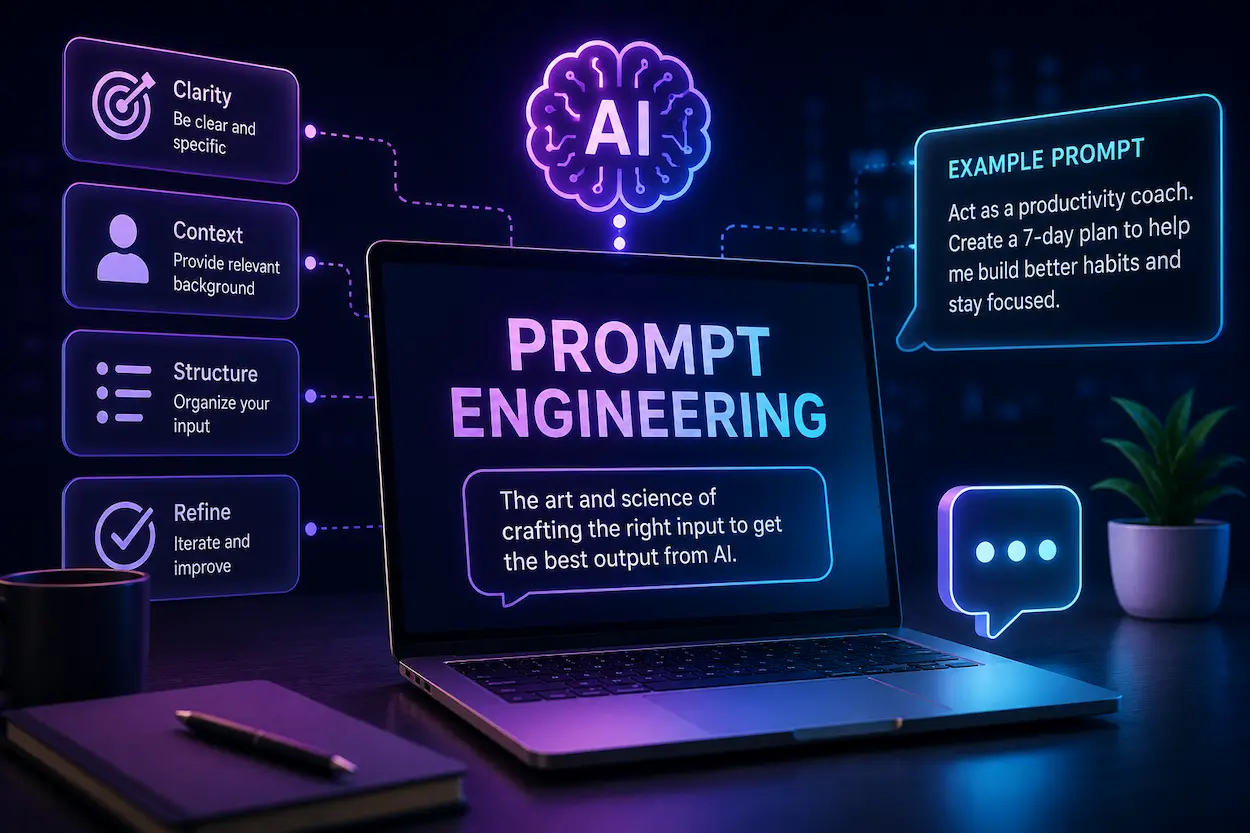
The AI systems, including ChatGPT, Claude, and Gemini will function just as good as you instruct them to function. Poor instructions, poor answers. Make a very specific, well-organized request, and you will receive what you require. That disparity between the guess and getting it right is the whole concept of prompt engineering.
It is the process of writing and designing the inputs (prompts) provided to an AI model in a way that makes sure that the output generated by the model is both accurate and useful. It consists of effective communication, the knowledge of how language models think and trial and error to keep improving the results.
Here you will know what prompting really is, how prompt engineering is done, who the prompt engineers are and how to begin developing this skill yourself, whether you are a marketer, developer or a complete beginner.
What Is Prompting? (Meaning and basics)
Prompting, at its most basic, is giving a machine learning model some instructions, a question, or a text fragment in order to receive a response from it. You have prompted an AI model before by asking a question through ChatGPT or Claude’s interface.
What is prompting definition: it is your instruction to a model which helps it understand what kind of output it should generate for you.
Prompt vs. Prompt Engineering — What’s the Difference?
One instruction or question is called a prompt. Prompt engineering is the wider field of designing, testing, and optimizing such prompts in order to achieve consistent and high-quality outcomes – particularly when the task is complex or repeated.
| Item | Prompt | Prompt Engineering |
|---|---|---|
| What it is | A single input | A repeatable process |
| Goal | Get an answer | Get the best answer, reliably |
| Skill level | Anyone can do it | Needs practice and form. |
One instruction or question is called a prompt. Prompt engineering is the wider field of designing, testing, and optimizing such prompts in order to achieve consistent and high-quality outcomes – particularly when the task is complex or repeated. A Simple Example
- Simple prompt: Write about marketing.
- Assignment Given: Create a prompt asking to write 300 words about the trend of email marketing of small e-commerce firms for the year 2026 as a digital marketing strategist.
The second variant assigns the model role, context, format, length, and tone – and the quality of the output speaks to it.
Prompt Engineering Defined (Core Definition)
The technical term prompt engineering is defined as the process of formulating inputs for large language models (LLMs) that will lead to specific outputs such as text, code, image, or structured data It is a crossroads of communication design, applied linguistics, and understanding of AI systems.
Why It Emerged as a Discipline
The ability to perform prompt engineering gained some form of recognition following the launch of massive language models, such as GPT-3, when developers and researchers found that the phrasing of a request would radically change the quality of the result, even though the underlying model remained identical. The necessity to constantly retrieve correct, helpful outputs made prompting less a hobby than a profession with the emergence of AI tools in the business world.
How It Differs from Traditional Programming
Conventional programming is strict in syntax and logic – the absence of a semicolon can ruin it all. Quick engineering is also based on natural language, meaning the rules are concerned with clarity, context and structure as opposed to syntax. It has more to do with writing code and less to do with writing accurate instructions that are well-reasoned and can be read by a model.
Why Prompt Engineering Matters in 2026
With the takeover of AI tools into daily business operations, the role of prompt engineering has shifted to a status of a nice-to-have and now a basic operational competence.
Business Use Cases
- Customer support: Writing prompts that create the correct and brand-centric answer.
- Content Creation: Blog post creation, ad copy creation, and product description creation.
- Coding: Code writing and code debugging.
- Data Analysis: Data summary and drawing inferences from the raw data.
Impact on accuracy, cost, and efficiency.
Badly formulated prompts may need to be regenerated several times, which is a waste of time (and in API-based systems, money) (including many AI systems, which charge by token). Properly designed prompts minimize back-and-forth, minimize wrong outputs, and ensure that AI tools can truly be trusted in business, which is why businesses are starting to specifically train employees on this skill.
Core Principles of Effective Prompting
Clarity & Specificity
Ambiguous prompts give ambiguous responses. State precisely what you want, format, length and tone.
Context-Setting
Give some context to the AI model in terms of the audience, purpose, or even constraints to ensure that the model does not need to make any assumptions.
Role/Persona Assignment
Giving directions to the model to assume the role of an expert (act as a nutritionist, etc.) can be highly effective for improving the tone and relevancy of the answer.
Few-Shot Examples
Consistency is much enhanced by demonstrating to the model 12 examples of the output you would like.
Iteration & Testing
The initial prompt may seldom give the ideal outcome. Prompt engineering is by its nature iterative – test, review, refine.
Types of Prompting Techniques
Zero-Shot Prompting vs. Few-Shot Prompting
Zero-shot prompting is where the model is provided with a task without any example. Few-shot prompting involves the use of sample inputs/outputs to specify the response style.
Chain-of-Thought Prompting
Promotes step-by-step reasoning in the model which enhances accuracy in complex reasoning or multi-step problems.
Role-Based Prompting
Giving the AI a particular character or skill to determine tone and richness of reply.
System Prompts vs. User Prompts
System prompts establish a high-level behavior and rules of the model; user prompts are the requests made within the framework – typical of API workflows and app building.
Who Is an AI Prompt Engineer?
An AI prompt engineer is a professional who develops, tests and optimizes prompts in order to achieve consistent and high-quality outputs of AI models – frequently at scale, on products, content pipelines or internal business applications.
Job Definition & Responsibilities
- Creating timely templates to do repetitive work.
- Prompts on various models (ChatGPT, Claude, Gemini)
- Recording what is working and improving on the quality of output.
- Working with product, content, or engineering teams.
Skills Required
- Strong written communication
- Basic knowledge of language processing by LLMs.
- Critical thinking and pattern recognition.
- Knowledge relevant to the use case domain (for instance, law, marketing, and health care).
Where Prompt Engineers Work
Timely engineers are employed in tech firms, marketing agencies, customer support software, AI products in the healthcare sector, and more often as freelancers or consultants to assist businesses in implementing AI workflows. It is common to use ChatGPT, Claude and Gemini APIs in the development and testing of prompt systems.
How to Become a Prompt Engineer
Learning Path
- Get familiar with the fundamentals of the operation of LLMs.
- Daily practice and sharpening of prompts.
- Prompting frameworks (few-shot, chain-of-thought, role-based)
- Test on a variety of AI environments.
Courses & Resources
Find organized courses offered by reputable AI providers and platforms, that include timely design basics, as well as practical experience with actual tools such as ChatGPT or Claude.
Building a Portfolio
Record actual prompt instances – before/after, use-case templates and output quality improvements that can be measured. This is usually more persuasive to employers than just certificates.
Salary Expectations
Quick engineering salaries differ by area, industry, experience, and in general, by position within the company, and the scope of the role, mid-level to high-technical/marketing salary ranges. As it is a rapidly developing area, it is always a good idea to visit existing job postings to see the latest statistics in your area.
Prompt Engineering Examples (Good vs. Bad)
| Bad Prompt | Good Prompt |
| Write a blog about SEO. | Write a blog post of 600 words about SEO for beginners (business owners) using easy language and 3 tips that work. |
| “Fix my code” | “Here is a Python function [paste code]. Identify the bug causing an IndexError and explain the fix in plain English” |
| Give me marketing ideas | “Act as a social media strategist. Recommend 5 post ideas on Instagram of a handmade candle company that targets Gen Z, the style of which is fun and casual. |
Before/After Example:
- Before: “Explain AI.”
- After: Provide an analogy in 100 words to a beginner about artificial intelligence.
Common Mistakes to Avoid
- Too imprecise: not specifying format, tone or length.
- Cutting corners: thinking that the model is familiar with your audience or purpose.
- Exceeding the capacity of a single request: overloading a single request with many instructions.
- Not iterating: Accepting the initial output rather than improving it.
- Neglecting examples: ignoring few-shot examples in cases of consistency.
FAQs
Q1: What is prompt engineering in simple terms?
In simple terms, prompt engineering is the creation of proper instructions to AI-based tools to make sure that they produce appropriate responses. It is the process of experimenting with prompts and making improvements to obtain better results from AI-based models like ChatGPT and Claude.
Q2: What is the difference between prompting and prompt engineering?
Prompting involves just providing an AI with one command or query. The systematic process of designing, testing, and refining those instructions to reliably generate high-quality products is called prompt engineering, particularly when it comes to a complex or repeated task.
Q3: Can prompt engineering be a good career in 2026?
Yes — with the rising count of businesses basing their operations on AI devices, the necessity in the personnel capable of creating efficient, trustworthy prompts in marketing, technology, and customer service professions is increasing. A roadmap can be found in the above section of How to Become a Prompt Engineer.
Conclusion
Prompt engineering is not a fad, it is rapidly becoming a core competence to operate with AI tools, be it a marketer or a developer. Learning the meaning of prompting, learning the fundamental methods, such as clarity, context, and iteration, and learning how professional prompt engineers think of their work should help you achieve better and better results when using any AI model.
Seeking more on AI skills? To understand how these concepts are related, check out our AI vs. Automation and AI in Business guides.
 Facebook
 Twitter
 Instagram
 Pinterest





Leave a Reply