
For the last three years, governments have responded to AI-related crises on a case-by-case basis, based on the news that has come up. This is the end of that era is upon us quickly. The AI safety regulation news updates are quite clear: regulators are switching from a reactive to a proactive approach when it comes to shaping AI regulation.
This change manifests itself in every direction. In the United States, patchwork state laws are being implemented, EU frameworks are in the process of being rolled out and in Asia, there are fast-moving rules that are creating a closer-to-unified global standard without a single treaty to bind them together. Aidukes monitors these changes on a regular basis as any non-compliance today is a legal issue within months, not years.
What is AI Safety Regulation?
AI safety regulation news refers to the collection of policy, legislation and enforcement actions to govern the development, deployment and monitoring of AI systems by companies. It’s there to deal with the real issues: skewed results, murky decision-making, data misuse and insecure deployment in high-stakes environments — the same concerns that shape how businesses approach AI chatbot integration responsibly today.
The general frameworks focus on four key areas, including data privacy, algorithmic bias, transparency and accountability. The dangers of AI safety regulation are those that are quietly discriminatory, those that tell people to eat supplements when they don’t need them and those that don’t even have an appeal process when they tell people to do something they shouldn’t. All big AI safety developments this year have been linked to one of these four areas.
AI Regulatory Developments 2026
The EU’s Digital Omnibus is a critical focus in AI regulatory developments 2026. On 29 June 2026 The European Council gave final approval and the package will go into force on 27 July 2026, while keeping the parts of the AI Act’s timeline unchanged but instead.
High risk system deadlines moved as a result. The obligations in Annex III (e.g., use-based systems, such as those employed in the hiring and credit-scoring sectors) were extended by 16 months to December 2, 2027, due to incomplete conformity-assessment infrastructure in the member states. One of the biggest AI regulatory advancement of 2026 thus far is this single change.

The situation is quite different in the U.S. President Trump has issued Executive Order 14365, which encourages the federal government to preempt state laws on AI and states such as California and Texas acted unilaterally with California’s TFAIA and Texas’s RAIGA taking effect on 1st January 2026. In 2026, it’s not just one law that determines AI safety regulation news, it’s parallel tracks and sometimes conflicting ones.
AI Safety Regulation Updates Today
The most relevant AI safety regulation updates today focus on enforcement dates, rather than proposals. The obligations under Article 50 of the EU AI Act on transparency for chatbots and content generated by artificial intelligence entered into force one year after the GPAI model obligations, putting fresh scrutiny on how generative AI tools disclose their outputs.
Colorado was a notable turnaround as well. In May 2026, the state repealed its original SB 24-205 structure and instituted a more limited SB 26-189, instead of applying the original broader risk-management requirements, and instead deferred core automated-decision-making functions to January 1, 2027.
On the federal level, Executive Order 14409 establishes a voluntary industry cybersecurity clearinghouse and orders the use of AI to support cyber defense operations which is signed June 2, 2026. The same move is an indicator of the evolution of AI safety regulation today, where regulation and national security policy are becoming increasingly intertwined, a development we’ll be monitoring through all of the subsequent AI safety regulation news cycles going forward.
Global AI Regulation Developments
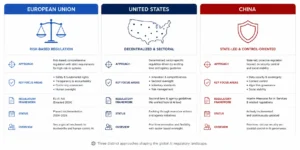
There are now three global approaches to regulation of AI. The EU proposes introducing a single horizontal AI regulation with a GDPR-range of extraterritoriality that will apply to any company who’s AI products affect EU users, no matter where they are based.
The US is not like that; they rely on existing agencies and a developing mosaic of more than 100 state laws already passed this year, rather than one federal law. China is in its own lane with six narrowly targeted and binding laws since 2022, including on algorithm recommendations, deep synthesis and generative AI in particular. Together, these global AI regulation developments reveal a trio of distinctly different approaches to regulation.
The trend is continuing, with South Korea’s AI Basic Act coming into effect on January 22, 2026. 3+1 is no longer 2+1, as we now have to monitor more than one compliance schedule for each cross-border AI safety regulation news.
What is Standard Does US AI Companies Follow?
Most US companies instead construct compliance to the NIST AI Risk Management Framework, rather than around a comprehensive federal AI law. The framework which was published in January 2023 and is voluntary provides a framework for risk management with four functions: Govern, Map, Measure and Manage. This matters most for the AI models companies choose to build on, since compliance expectations increasingly follow the tool, not just the deployer.
It is a misleading status in reality. Nonetheless, the NIST AI RMF principles are now being explicitly cited in relevant regulatory enforcement guidance and this reference does not require a law to mandate its use as a standard. Knowing what standards US AI companies adhere to begins here, followed by state-specific processes on top.
The list below is a good compliance checklist and a quick answer to the question: What is standard does US AI companies follow on a day-to-day basis?
- Align each AI system in the organization to the four functions of the NIST AI RMF.
- Ensure that you monitor obligations in each state in which you do business.
- Record risk assessment and mitigation measures as proof.
- Watch for changes in compliance expectations quarterly with regard to federal executive orders.
- Evaluate vendor / third-party AI tools to the same standard
Conclusion: Staying Ahead in the AI Regulation Landscape
The moment that regulators set real deadlines for AI safety regulation news, it became mandatory. Those who integrate compliance into their AI solutions are now enjoying a real competitive advantage: smoother audits, no legal surprises and more trust with customers who are increasingly asking how their data is being used. Keeping up with the news on AI safety doesn’t need to be your burden anymore, it’s part of doing business.
The actual way forward remains straightforward despite the number of rules increasing. Follow the progress of AI developments as they arrive and compare your systems to the NIST AI RMF, audit your AI tools on schedule, rather than waiting for a regulator to audit them first.
If you want to see in detail how these rules will affect your own AI stack, check out Aidukes‘ comprehensive AI Ethics & Regulation coverage and don’t worry about the deadline, just prepare for it!
FAQs
Which countries have the toughest AI safety laws?
The toughest laws today are the GDPR-like extraterritorial enforcement and penalties according to turnover which is the most comprehensive framework in the EU. Since 2022, China has introduced six sectoral regulations and is now neck and neck with the EU.
What can be done to keep businesses informed about new AI legislation?
Ensure that the AI systems you deploy are aligned with the NIST AI RMF, monitor state and regional legislation you are subject to and audit compliance status every quarter. Documentation should not be a checklist but rather a continuous piece of evidence.
What are the consequences of non-compliance with AI safety rules by a company?
Penalties will differ depending on jurisdiction, from fixed fines under state legislation, such as Colorado’s, to turnover-based penalties under the EU AI Act. Failure to comply with the terms of the fine can alsoe lad to regulatory investigations and damage to reputation, in addition to the fine itself.
Do US companies have to use NIST AI RMF?
No, it’s still volunteer. The term is becoming a necessity for businesses in regulated industries, however, as it is increasingly referenced in enforcement guidance by agencies such as the FTC, FDA and SEC.
At what rate are AI safety regulation news evolving?
Frequently. Between the EU AI Act and the 2026 Digital Omnibus, a significant timeline shift occurred and in the first half of 2026 alone more than 100 new AI laws were passed in the United States. AI safety regulation news come out each and every month, not once a year.The practical minimum now is updating compliance teams monthly about AI safety regulations.
 Facebook
 Twitter
 Instagram
 Pinterest






Leave a Reply